Benefit corporation / PBC
A for-profit legal form under state law. It can issue shares and earn profits. The charter and statute define its public mission, board duties, and reporting obligations.
See Delaware’s PBC law ↗A field guide to purpose-driven business
You can build a company that earns money and serves a public mission. Where you form it changes the rules.
Source review: October 11, 2026 · U.S. for-profit corporations
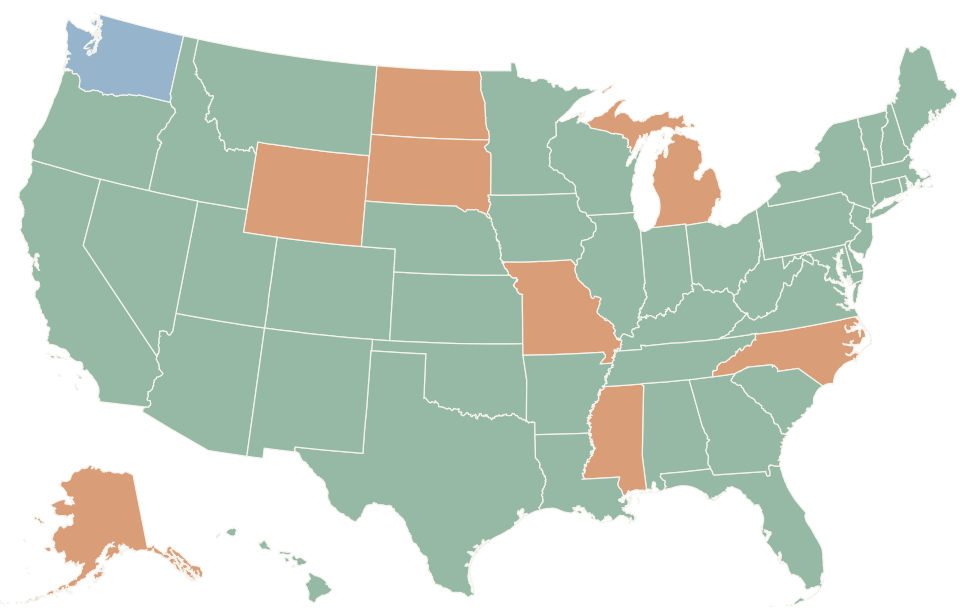
A legal form is only the starting point. The duty, disclosure, and enforcement rules differ.
02 / Get your bearings
“PBC” is not exclusive to Delaware. States use several names for companies that combine profit with a public purpose.
A for-profit legal form under state law. It can issue shares and earn profits. The charter and statute define its public mission, board duties, and reporting obligations.
See Delaware’s PBC law ↗A private certification administered by B Lab. It is separate from incorporation. Benefit status does not automatically confer certification, and a statute need not require a paid certification.
B Lab’s explanation ↗A different corporate category. Similar wording in a nonprofit statute does not establish a for-profit PBC option. That distinction matters in Wyoming.
Wyoming Title 17 ↗50 states / Selected statutory provisions
Compare the actual duties, claimants, monetary limits, reporting work and voting rules. Open each state’s individual record, or compare three states side by side.
Nevada has a default director and officer damages rule. Delaware uses an opt-in charter provision, with narrower officer coverage. South Carolina’s ordinary director exculpation provision has size or public-company eligibility requirements.
Compare these rules ↗Ohio imposes no annual benefit-report mandate in its benefit provisions. Iowa allows an optional third-party standard. Kansas requires an annual public report assessed against one, despite using a balancing model.
Compare reporting ↗Kentucky requires 90% of each class to convert an existing company into benefit status. Virginia requires unanimity of entitled shareholders to convert. Oregon generally uses majority voting for a new private company, subject to ordinary law and governing documents.
Compare votes ↗My starting recommendation if you expect institutional investment: a specific-benefit PBC, flexible reporting and a widely used corporate framework. Investor familiarity is an inference from adoption. The state-page preference index does not score financing, court quality or valuation.
PBC law ↗ Corporate adoption ↗A serious alternative when default director and officer protection is the priority. Its benefit corporation requires annual public assessment. The $150 minimum annual list plus $500 business license gives a $650 known recurring minimum before other costs.
Benefit law ↗ Liability rule ↗No universal best state follows from these statutes. A monetary limit for a corporate fiduciary or benefit-duty claim does not waive campaign-finance law or protect your individual illegal conduct. Your operating state, charter, insurance and exact activities still matter.
Explore all 50 state records ↗What matters most to you?
These are research-based tradeoffs, not a prediction of company value or a personalized legal recommendation. Where you actually operate can add registration, tax, and employment obligations.
04 / Read the protection carefully
When someone says “personal protection,” ask which kind of claim they mean.
Corporate limited liability generally separates shareholder assets from company obligations. Personal guarantees, individual wrongdoing, and veil-piercing can change the outcome.
Example: Wyoming §17-16-622 ↗Nevada provides a broad default statutory rule for certain director and officer damages claims. Delaware combines business-judgment protection with optional charter exculpation and conditional indemnification. Scope and exceptions matter.
Benefit status does not waive campaign-finance law. Prohibited corporate contributions, coordination, and duties imposed directly on officers remain governed by election law. “Civic education” is a description of activity, not an automatic exemption.
05 / Know the recurring baseline
Compare registration-related minimum charges for an ordinary, non-exempt stock corporation in these three states. Add your own assumptions for agent and operating-state costs. Delaware’s separate operating business license is additional when applicable.
This calculator uses registration charges; the 50-state scores use a stated local operating scenario. This is not a formation quote or full tax calculation. It excludes formation charges, income and other taxes, legal fees, insurance, and costs you have not entered. Delaware’s share structure and Wyoming assets can increase the state charge.
The $150 agent figure is an editable assumption, not a provider quote.
07 / A goal worth making concrete
States can create their own benefit corporation laws. A national adoption effort should pursue a meaningful mission duty, affordable transparency, and protection for sound board decisions.
The current research plan identifies eight access gaps. Washington’s related model presents a separate policy question. This is a proposed roadmap; legislation and outreach have not been completed.
The expanded goal covers both missing benefit laws and barriers facing existing for-profit companies: direct charter election, ordinary entry votes, affordable filing and practical mission reporting.
Explore the conversion goal and proposed legislation ↗Use the 50-state inventory. Separate existing laws, related forms, and pending bills. Keep the legal sources and review date visible.
Research baseline completeReview SB 789 with state corporate counsel. It was introduced and referred to committee on February 18, 2026; a bill is not an enacted formation option.
Official bill history ↗Develop local support, legislation, hearings, enactment, an effective date, and usable filing forms. Then measure reporting burden and real uptake.
Proposed next stageA for-profit stock company elects the form in its charter. Existing companies can convert with informed shareholder approval.
Identify public benefits with measurable objectives. Require a board to balance financial interests, affected stakeholders, and its stated mission.
Protect informed, disinterested, good-faith mission decisions. Preserve exceptions and liabilities imposed by other laws.
An annual public benefit report with goals, measures, results, failures, and narrow privacy or trade-secret redactions. No blanket paid-certification mandate.
Consider a two-thirds vote of each affected group for major mission changes. Keep permanent mission or asset locks optional and explicit.
Provide qualifying shareholders a route to mission relief and all shareholders a route to missing reports. Define cure, consequences, and reinstatement.
Proposed choices for legislative counsel to adapt. They are not enacted nationwide rules or a filing-ready model bill.
08 / Show your work
Legal claims link to government statutes, filing guidance, or bill records. Source types vary: some states have a full statutory review; others use official forms or code contents to establish availability.
How to read this research. Reviewed October 11, 2026. The linked compilations may have different update dates. Selected statutory dimensions are reviewed individually for all 50 states. The comparison discloses official enactment sources, inaccessible current-code text and unresolved conflicts. Verify amendments and filing requirements before acting. This is educational research, not a substitute for counsel reviewing your actual operations and charter.
Download the 50-state data ↓Map geometry comes from the open-source US Atlas project, derived from U.S. Census cartographic boundaries, using TopoJSON Client. Boundaries visualize states; they are not a legal map of jurisdiction. US Atlas license.
The recurring-fee calculator covers Delaware, Nevada and Wyoming only. It shows statutory minimums plus your inputs. Availability does not confirm a proposed company name, foreign qualification, tax treatment, certification, or that a business has been formed.
Primary-source review: October 11, 2026. Full current code could not be independently accessed for every provision; official enactments and conflicts are labeled in each record. Registered-agent service and all company-specific taxes are not fully compared.